
Dyscalculia information
Definition
The term ‘dyscalculia’ derives of Greek origin: dys’ – problems with and ‘calculia’: to count.
Numerical skills are present in both hemispheres of the brain. Neuropsychological evidence indicates that the parietal lobes are actively involved when mathematical and arithmetical operations are executed, in the intra-parietal sulcus (SIP), where quantity and size of objects are calculated, also estimation and organization of information associated with it.
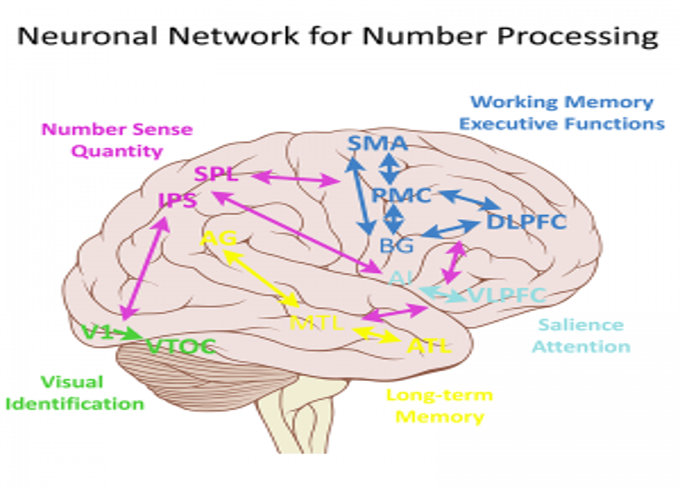
Underlying causes
- Visual-spatial difficulties-trouble processing what the eye sees.
- Weakness in visual processing of numbers and mathematical situations
- Auditory processing difficulties- trouble processing and making sense of what the ear hears.
- Attention deficits.
- Memory problems.
- Information processing deficits.
- Motor disabilities.
- Problems with sequencing, organizing information.
- Problems with understanding concepts and symbols.

Symptoms
Pre-school
- Difficulty with number sense.
- Difficulty learning to count.
- Trouble recognizing printed numbers.
- Difficulty with connecting the idea of a number with what it represents in the real world.
- Poor memory for numbers.
- Trouble organizing things in a logical way, sorting by shape, size, color.
- Trouble recognizing groups and patterns.
- Trouble comparing and contrasting, smaller/larger, taller/shorter.

Primary school
- Trouble learning math facts.
- Difficulty developing mathematical problem-solving skills.
- Poor long-term memory for math functions
- Not familiar with math vocabulary.
- Difficulty with measuring things
- Avoiding games that require strategy.
- Visual-spatial difficulties hinder comprehension of written mathematics.
- Difficulties reading a clock.
- Problems with time perception, that often leads to problems with planning time required to complete a task.
High school and adults
- Difficulty estimating cost (shopping, groceries).
- Difficulty learning math concepts beyond basic math facts.
- Poor ability to budget or balance a checkbook.
- Trouble with concepts of time, such as going by a schedule or approximating time.
- Trouble with mental mathematics.
- Difficulty finding different approaches to one problem.
- Trouble with visualizing patterns or different sections of a math problem or identifying critical information needed in problem solving.
Diagnostic criteria
In 1974 Ladislav Kosc defines mathematical difficulties as ’a difficulty in mathematical performance resulting from impairment to those parts of the brain that engage in mathematical processing, without a simultaneous impairment in general mental function’.
Dyscalculia is a mathematical difficulty when the performance measured by individually administered standardized tests is:
- below the expected level given the person’s chronological age, measured intelligence, and age-appropriate education (2 YEARS BELOW GRADE/EDUCATIONAL LEVEL), and
- mathematical difficulties significantly interfere with academic achievement or activities of daily living that require mathematical ability.
There are no single universally accepted tests for diagnosing dyscalculia. A variety of standardized mathematical tests must be used to make an accurate diagnosis of dyscalculia. A psychometric test conducted by a psychologist or psychiatrist must be performed to determine the general cognitive ability as well as the level of attention and concentration of the candidate.



Remedial strategies
The first step must be to identify the learner’s strengths and weaknesses, and to understand how a learner learns best. These include:
- Use tutoring outside the classroom, with a one-on-one instructor.
- Encourage repeated reinforcement and specific practice.
- Use graph paper to organize work and ideas.
- Use different approaches to memorizing math facts, formulas, rules.
- Practice estimating as a first step to solve a problem.
- Encourage students to work hard to “visualize” math problems, draw pictures, look at diagrams, etc.
- Encourage verbalizing while problem solving, this uses auditory skills which may be a strength.
- Try to relate problems to real life experiences.
- Provide uncluttered worksheets, preferably lined.
- Use rhythm or music to help memorize math facts.
- If possible, let THE LEARNER take tests one-on-one in the TEACHER’s presence.
- Allow extra time to complete work if needed.
- Be aware if THE LEARNER becomes panicky, provide reassurance.
- Monitor LEARNER’S progress on a frequent basis.
- Teach important concepts to mastery.
- If needed, allow a calculator for basic operations to allow focus on problem solving.
- Be patient. Math can be a traumatic experience and is highly emotional because of past failures.
Accommodations
- Extra time.
- Separate venue.
- The use of a calculator during class work, tests, and examinations.
- A reader for Mathematics tests and examinations.
Concessions
- The learner may not fail his/her grade due to failing Mathematics.
- The learner may in Grade 10 choose any other subject in the place of Mathematics of Mathematics Literacy.